



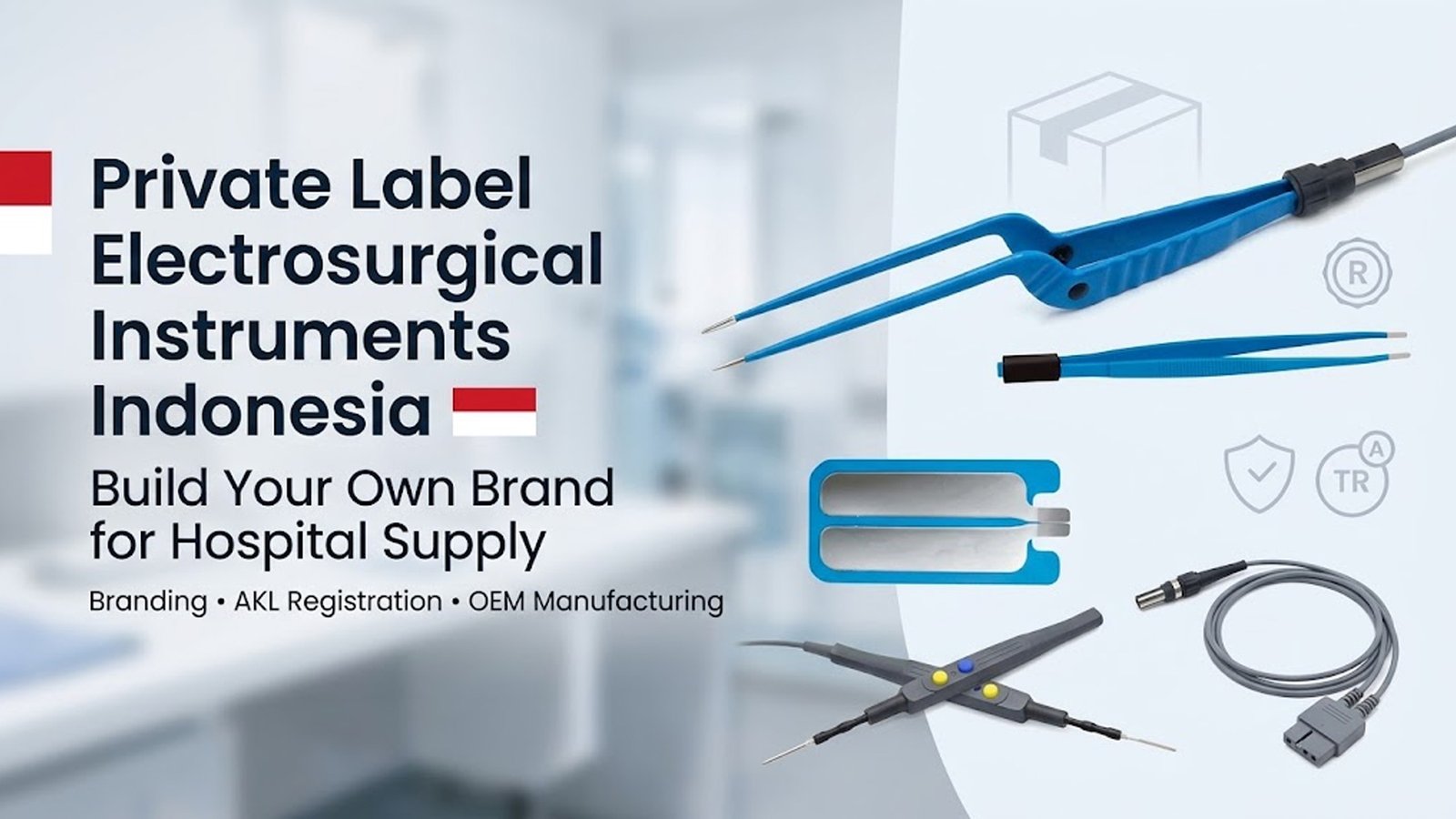
 For many Indonesian medical distributors, selling another company’s brand means competing on price for the same product codes as every other importer. A private-label electrosurgical range, produced by an established manufacturer under the distributor’s own brand, gives the distributor control over its catalogue, its hospital relationships and its margins. This guide explains how to plan a private-label range of bipolar forceps, diathermy pencils, cables and return electrodes, and what to check before choosing a manufacturer.
A private-label electrosurgical range lets an Indonesian distributor sell instruments made by a qualified manufacturer under its own brand. Success depends on choosing standard, high-reorder products first, protecting the brand as a trademark, securing AKL registration with consistent documentation, and working with a manufacturer that controls quality and notifies product changes.
Private Label vs Reselling a Manufacturer’s Brand
| Factor | Reselling a manufacturer’s brand | Private label |
|---|---|---|
| Brand ownership | Belongs to the manufacturer | Belongs to the distributor |
| Price competition | Other importers may offer the same product | Hospitals compare on value, service and approval history |
| Hospital loyalty | Attached to the product brand | Attached to the distributor’s brand |
| Upfront work | Lower | Higher: branding, labelling and registration planning |
The main commercial value of a private label is continuity: once hospitals approve and reorder a branded product, the distributor keeps that business even if it later changes or adds suppliers behind the brand, subject to new registrations where required.
Choosing the First Products
Start with products that hospitals reorder regularly and that have standard specifications:
- Bipolar forceps in common patterns such as straight and bayonet, in standard lengths and connector types. See the bipolar forceps selection guide.
- Single-use diathermy pencils, which generate recurring orders. See the cautery pencil selection guide.
- Patient return electrodes matched to the generators your hospitals use. See the patient return electrode selection guide.
- Cables that connect the range to installed generators. See the electrosurgical cable compatibility guide.
Specialty items such as micro bipolar forceps or laparoscopic instruments can follow once the core range is established.
Branding Decisions to Make Early
- Brand name and trademark. Register the trademark in Indonesia before investing in packaging and marketing. Kemenkes registration guidance also refers to brand documentation.
- Product marking. Decide what appears on the instrument itself, such as brand name and product code, and confirm the manufacturer can mark it permanently.
- Packaging and labels. Labels must carry the regulatory information required in Indonesia, and the content must match the registered product description.
- Instructions for use. Plan for IFU content that can be presented in Bahasa Indonesia and matches the manufacturer’s validated instructions.
- Product codes. Keep a clear cross-reference between your codes and the manufacturer’s codes to avoid ordering and registration errors.
Registration Considerations in Indonesia
Private-label products are imported medical devices and need an AKL marketing authorisation before they are sold. The registration identifies the actual manufacturer, so a private label does not change what the regulator reviews: manufacturer authorisation, quality management evidence, Certificate of Free Sale and technical documentation. The AKL registration guide for electrosurgical imports explains the process in detail.
Consistency is critical for private-label registration. The brand name, product names and specifications must match across the Letter of Authorization, Certificate of Free Sale, technical file, labels and catalogue.
Discuss the private-label structure with a licensed Indonesian regulatory consultant before finalising labels, because requirements can change.
What to Check in a Private-Label Manufacturer
- Does it manufacture in its own facility, or does it subcontract production?
- Is its quality management certification current, with a scope covering the products you plan to brand?
- Can it supply complete technical documentation and a Certificate of Free Sale that support your registration?
- Can it mark instruments and produce packaging to your brand specifications consistently across batches?
- Does it run formal change notification, so you know about any design, material or labelling change before it affects your registration?
- Can it scale supply as your hospital accounts grow?
ERMC Private-Label and OEM Supply
Electro Range MFG Co. (ERMC) has manufactured electrosurgical instruments in its own facility in Sialkot, Pakistan, since 2006, and supplies OEM and private-label programmes for distributors. The range includes bipolar and monopolar forceps, diathermy pencils, active electrodes, cables and patient return electrodes. Distributors planning a private-label range for Indonesia can discuss product scope, marking, packaging and documentation needs with ERMC. Learn more about the electrosurgical manufacturer partnership for Indonesia.
This article offers general commercial guidance and is not legal or regulatory advice. Confirm trademark and registration requirements with qualified advisers in Indonesia.
Frequently Asked Questions
What is a private-label electrosurgical instrument?
It is an instrument made by a medical device manufacturer and sold under the distributor’s own brand name, with the distributor’s branding on the product marking, packaging and labels. The manufacturer remains responsible for production and quality documentation.
Does a private-label product still need AKL registration in Indonesia?
Yes. An imported private-label device needs an Indonesian marketing authorisation like any other imported medical device, and the registration documents identify the actual manufacturer. Branding changes the name on the product, not the regulatory requirements.
Should a distributor register its trademark before launching a private label?
It is advisable. Kemenkes registration guidance refers to brand documentation, and registering the trademark in Indonesia early protects the distributor’s investment in the brand. Confirm current requirements with a regulatory consultant.
Which electrosurgical products suit a first private-label range?
Products with steady reorder demand and standard specifications, such as bipolar forceps in common patterns, single-use diathermy pencils, patient return electrodes and matching cables, are practical starting points.