



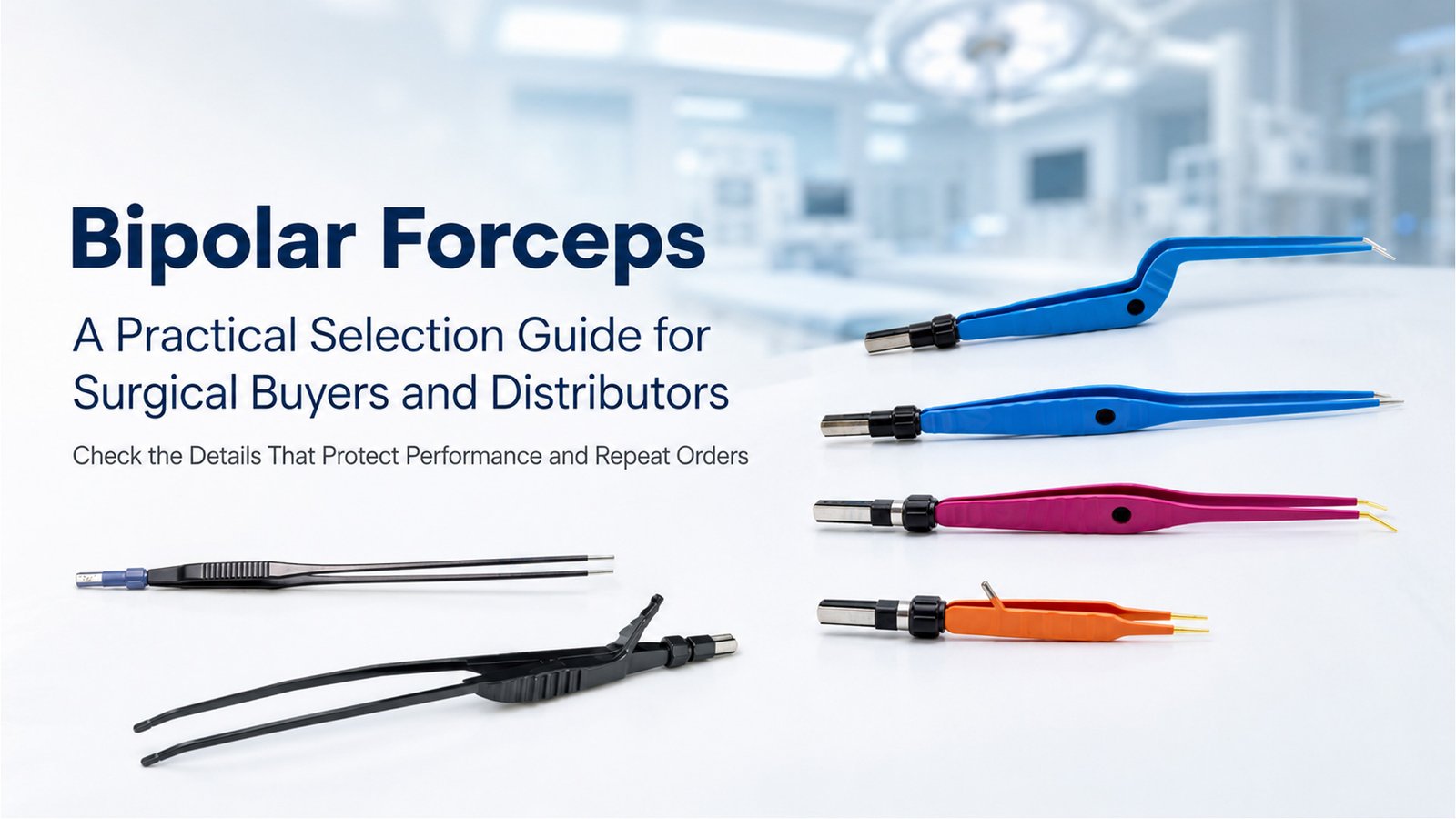
Before You Source Bipolar Forceps, Check the Details That Protect Performance and Repeat Orders
Two forceps can look almost identical in a catalogue yet feel very different in use. Tip geometry, tine alignment, insulation, connector construction and closing pressure all influence how an instrument handles tissue and performs within a bipolar electrosurgical system. For procurement teams, these details also affect complaints, repeat orders and long-term confidence in the product line.
That is why selecting Bipolar Forceps should involve more than comparing article numbers or unit prices. Hospitals, distributors and OEM buyers need a range that combines appropriate instrument design, consistent production, clear documentation, compatible accessories and dependable supply.
This guide explains the principal types of Bipolar Forceps, the specifications buyers should examine and the questions worth asking before approving a product or expanding a surgical supply programme.
What Are Bipolar Forceps?
Bipolar Forceps are electrosurgical instruments with two opposing tips that act as the two poles of a bipolar circuit. When used with a compatible electrosurgical generator and connecting cable, current passes between the tips through the tissue held between them.
Because energy is concentrated between the two tips, bipolar instruments support localised coagulation and controlled tissue handling. They are an established part of modern Electrosurgery, particularly where precision and access are important.
The intended procedure, instrument pattern, generator connection and manufacturer’s instructions must always guide selection. Buyers should never assume that every bipolar pattern or connector is interchangeable.
Why Product Selection Matters Beyond the First Order
Clinical users naturally focus on handling and performance. A distributor must consider those expectations alongside commercial realities: stock continuity, stable specifications, documentation, packaging, complaint handling and repeat production.
A well-planned Bipolar Forceps portfolio can help a supplier:
- Serve different preferences through appropriate lengths, patterns and tip configurations.
- Offer reusable, non-stick, specialty and single-use options within one organised category.
- Reduce ordering errors through clear article numbers and specifications.
- Support hospital evaluations, tenders, distributor programmes and OEM enquiries.
- Build repeat business through consistent products and responsive technical support.
The strongest purchasing decision is not the forceps with the longest feature list. It is the instrument that fits the intended use and can be supplied consistently with the information buyers need.
Main Types of Bipolar Forceps
Standard Bipolar Forceps
Standard Bipolar Forceps cover familiar reusable patterns for general bipolar coagulation requirements. Depending on the manufacturer’s range, options may include straight, angled, bayonet, Adson, Jeweller and McPherson-style configurations in different working lengths and tip dimensions.
For distributors, the goal should be to identify the patterns their customers actually require. A focused core range is often easier to explain, stock and support than a crowded catalogue filled with near-duplicate configurations.
Non-Stick Bipolar Forceps
Non-Stick Bipolar Forceps are designed to reduce tissue adhesion at the working tips during coagulation. This category can be valuable for buyers seeking more consistent tip behaviour and easier handling during repeated activation.
Electro Range MFG Co. describes its reusable forceps range as incorporating polished gold-plated tips, ergonomic handling, resin-free connectors, slim insulation and stopper-guided tine alignment. Its non-stick category includes straight, bayonet, Adson, Jeweller, McPherson and irrigation configurations, with angled options available across the range.
Buyers should still review the exact specification of every article. A category-level claim does not replace product-specific confirmation of dimensions, materials, intended use and compatible accessories.
Special Bipolar Forceps
Special Bipolar Forceps are developed for defined access, handling or procedural requirements. Their value comes from purposeful geometry, such as a particular shaft shape, working length, tip profile or irrigation feature.
Before adding a specialty model, confirm its intended application, exact configuration, cable connection, reusable or single-use status and relevant handling instructions. This prevents an instrument from being purchased only because its name sounds specialised.
Single-Use Bipolar Forceps
Single-Use Bipolar Forceps provide a sterile, procedure-ready alternative for supply programmes that use disposable instruments. They may be suitable where workflow standardisation, reprocessing capacity or facility policy supports a single-use format.
When evaluating Single-Use Forceps, buyers should examine sterile-barrier information, shelf life, packaging integrity, labelling, storage requirements and traceability. Cost should be calculated per procedure rather than by comparing the unit price directly with a reusable instrument.
Which Bipolar Forceps Category Fits the Requirement?
| Product Type | Typical Purchasing Need | Key Point to Verify |
| Standard Bipolar Forceps | Core reusable instrument programmes | Pattern, dimensions, durability and reprocessing instructions |
| Non-Stick Bipolar Forceps | Reduced tissue adhesion at the working tips | Tip construction, finish, alignment and product-specific claims |
| Special Bipolar Forceps | Defined access or specialty requirements | Intended application, geometry and compatibility |
| Single-Use Bipolar Forceps | Sterile, procedure-ready supply | Packaging, shelf life, traceability and cost per procedure |
Many distributors need more than one category. A practical portfolio may combine high-demand reusable patterns with selected non-stick, specialty and single-use options. The right mix should reflect customer demand, not a desire to list every available configuration.
Nine Details Buyers Should Evaluate
- Tip Geometry and Surface Finish
Tip width, length, profile and finish influence tissue engagement. Even instruments with the same general pattern name may differ between manufacturers. Request dimensional information and ensure that evaluated samples match the specification proposed for production.
- Tine Alignment and Closing Pressure
The two tines should meet in a controlled and repeatable manner. Buyers should examine alignment at rest and during closure, along with the pressure needed to bring the tips together. A supplier should be able to explain how these characteristics are checked during production.
- Insulation Coverage
Insulation should be uniform, secure and appropriate for the instrument design. Inspect the main insulated area as well as transitions near the tip and connector. For reusable products, obtain the approved inspection and reprocessing instructions. Damaged instruments must be handled according to the manufacturer’s guidance and facility policy.
- Connector and Cable Compatibility
Similar-looking connectors are not automatically interchangeable. Document the required connector, compatible cable reference and intended electrosurgical system before placing an order. This is especially important for distributors serving facilities that use different generator brands.
- Ergonomics and Balance
Length, handle width, grip texture, spring tension and balance influence how the instrument feels in the hand. Photographs cannot communicate these details. Representative samples should be assessed in the exact configuration proposed for purchase.
- Material and Production Consistency
The delivered instrument should continue to match the approved sample across repeat orders. Ask how the manufacturer controls incoming materials, critical dimensions, insulation, alignment and finished product inspection. A capable Bipolar Forceps Manufacturer should be able to answer these questions clearly.
- Reusable or Single-Use Status
Never infer reusability from appearance. Confirm the labelled status and instructions for each article. Reusable products require appropriate cleaning, inspection and sterilisation guidance, while single-use products require sterile packaging, shelf-life control and clear traceability.
- Product Identification
Article numbers, descriptions, sizes, tip configurations and packaging details should remain consistent across quotations, samples, labels and invoices. Clear identification reduces ordering mistakes and makes complaints or repeat orders easier to manage.
- Documentation for the Destination Market
Documentation requirements depend on the device, intended use and destination market. Buyers should request documents that apply to the exact product rather than accepting an unrelated certificate bundle.
- Manufacturer and product identification
- Applicable quality-management documentation
- Conformity information relevant to the device and market
- Instructions for use and reprocessing information
- Labelling and packaging specifications
- Sterilisation and shelf-life evidence for sterile products
- Traceability, complaint and change-control procedures
Qualified regulatory personnel should review market requirements before a device is placed on the market or used clinically.
What Distributors Should Expect From a Bipolar Forceps Manufacturer
A reliable manufacturing relationship extends beyond the first shipment. Distributors should expect a clearly organised range, controlled samples, consistent specifications, realistic lead times and responsive technical communication.
For OEM or private-label programmes, agree on branding, artwork, packaging, language versions, minimum quantities, document responsibilities and change notification before production begins. These decisions are easier to manage at the start than after products have entered distribution.
Common Sourcing Mistakes to Avoid
- Comparing only unit price: complaints, replacements, documentation gaps and stock risk can quickly outweigh a small price difference.
- Approving from photographs: images do not confirm alignment, spring tension, insulation quality or connector fit.
- Assuming pattern names guarantee equivalence: straight, bayonet, Adson and McPherson designs can vary in important dimensions.
- Ignoring the connection pathway: forceps, cable and generator must be confirmed as a compatible system.
- Accepting generic documents: paperwork should relate clearly to the selected manufacturer, product and market.
Why Buyers Consider Electro Range MFG Co.
Electro Range MFG Co. offers a broad Electrosurgical Instruments portfolio that includes standard, non-stick and special forceps, sterile single-use options and related electrosurgical accessories.
ERMC states that it has manufactured electrosurgical instruments since 2006 and supplies distributors in more than 38 countries. Buyers can request product specifications, catalogue information, samples and documentation for the exact articles and destination markets they are evaluating.
Frequently Asked Questions
What are Bipolar Forceps used for?
Bipolar Forceps grasp tissue and deliver energy between their two tips when connected to a compatible electrosurgical system. The exact use depends on the instrument design, intended procedure and approved instructions.
What is the difference between standard and Non-Stick Bipolar Forceps?
Standard models provide conventional bipolar configurations. Non-Stick Bipolar Forceps use tip construction or materials intended to reduce tissue adhesion during coagulation. Buyers should review product-specific specifications and claims.
Are all Bipolar Forceps reusable?
No. Reusable and Single-Use Bipolar Forceps are available. Confirm the labelled status, packaging and instructions for every article.
How should distributors compare suppliers?
Compare samples, specifications, tip alignment, insulation, compatibility, documentation, traceability, production consistency, lead times and post-sale support—not only price.
Can Bipolar Forceps be supplied under an OEM brand?
OEM options may be available subject to the manufacturer’s capabilities and destination-market requirements. Branding, labelling, packaging, quantities and documentation responsibilities should be agreed before production.
What belongs in a quotation request?
Include the pattern, length, tip dimensions, reusable or single-use status, connector requirements, quantity, destination market, packaging preference and any OEM or documentation needs.
Build a Bipolar Forceps Range for Long-Term Supply
The right Bipolar Forceps programme brings together appropriate instrument design, clear specifications, compatible accessories, market-relevant documentation and reliable repeat production. A structured evaluation helps protect both user expectations and commercial performance.
Explore the ERMC Bipolar Forceps range or email info@electrorange.com to request a catalogue, technical specifications, samples, OEM information or a quotation.
Related Electro Range Articles
- Bipolar Forceps for Laparoscopic Surgery: Electrosurgical Instrument Supply for Professional Surgical Markets
- Bipolar vs Monopolar Electrosurgery: Clinical and Commercial Perspectives
- Single Use Bipolar Forceps France: A Detailed Procurement Guide
- Choosing an Electrosurgical Manufacturer for Modern Surgical Supply