



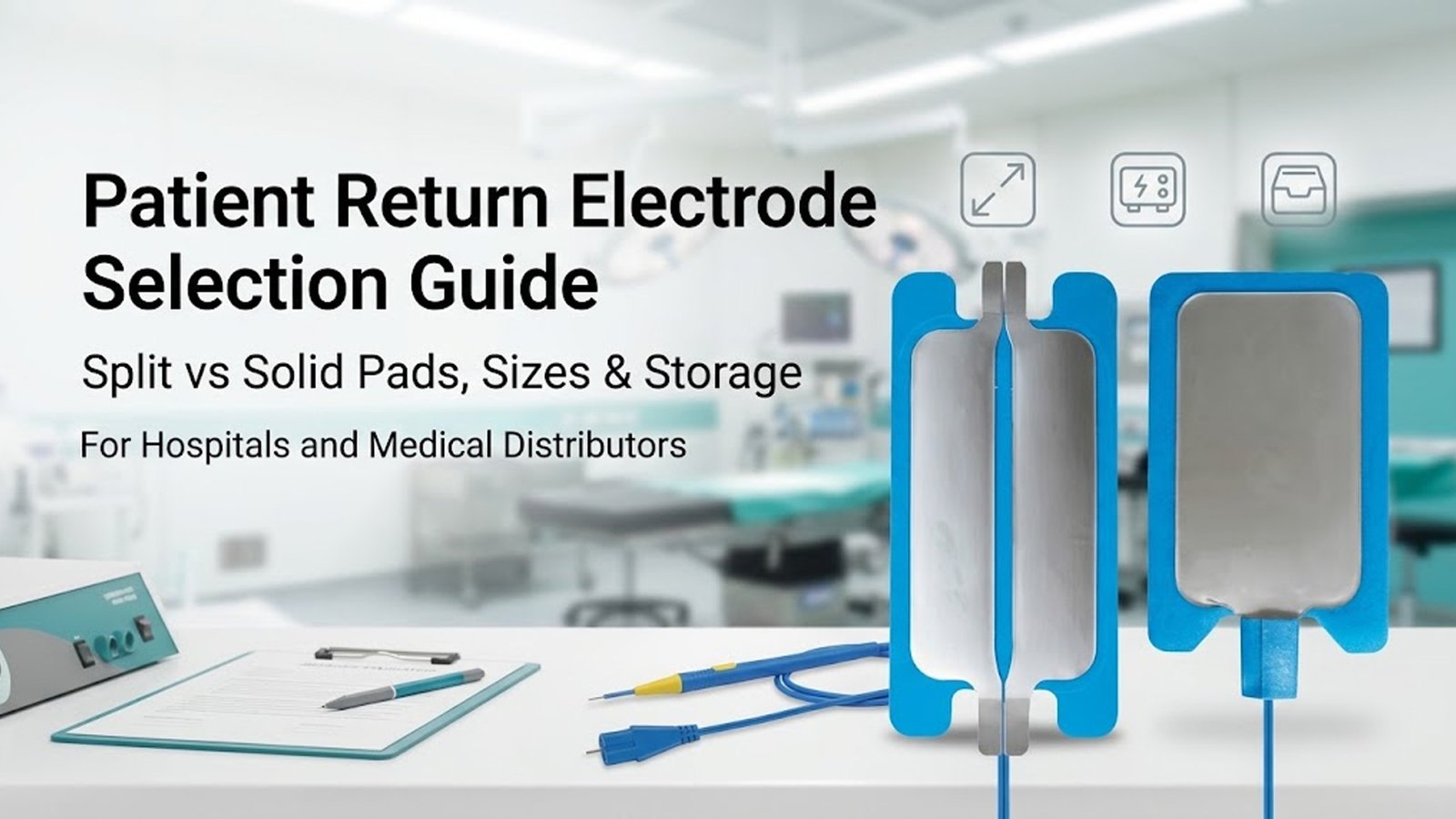
 Every monopolar electrosurgical procedure depends on the patient return electrode. It is one of the lowest-cost items in the circuit, yet poor pad selection, placement or storage is a recognised cause of return-site skin injury. This guide covers what hospitals and distributors should consider when choosing split or solid return electrodes, sizes and stock management.
A patient return electrode completes the monopolar electrosurgical circuit by spreading current over a large skin area. Hospitals should match the pad type to their generators, choosing split pads where contact quality monitoring is available, select the correct patient size, and store pads within the label’s temperature and humidity limits.
What a Return Electrode Does
In monopolar electrosurgery, current flows from the active electrode, such as a diathermy pencil or active electrode, through the patient and back to the generator through the return electrode. The active electrode is small to concentrate current and produce a surgical effect. The return electrode is large so that current density at the return site stays low.
If the contact area of the return electrode shrinks, because of poor adhesion, lifting edges or fluid, the same current passes through a smaller area and heating at the pad site increases. That is why pad design, placement and condition matter.
Bipolar instruments do not need a return electrode because current passes only between the two tips of the forceps. For more on the difference, read bipolar vs monopolar electrosurgery.
Split vs Solid Return Electrodes
| Feature | Split (dual-area) pad | Solid (single-area) pad |
|---|---|---|
| Design | Two separate conductive areas | One continuous conductive area |
| Contact quality monitoring | Supported on compatible generators, which measure impedance between the two areas and stop output if contact deteriorates | Not supported; the generator can typically confirm only that the pad is connected |
| Typical use | Theatres with modern generators offering contact monitoring | Generators without contact monitoring, or where specified by the generator manufacturer |
| Procurement note | Confirm the cable connector matches the generator’s return socket | Confirm the generator accepts single-area pads |
Where a hospital’s generators offer contact quality monitoring, split pads let that safety feature work. Buying solid pads for those generators to save cost removes the benefit of the monitoring system.
Choosing the Right Size
Return electrodes are generally offered in adult, paediatric and neonatal sizes. Selection is based on patient weight ranges stated in the manufacturer’s instructions for use. A pad that is too large for a small patient may not achieve full contact, and a pad that is too small may not provide enough contact area.
Large reusable capacitive return pads, placed under the patient, are another option in some hospitals. They follow different principles of use and must only be used with generators and settings approved by their manufacturer.
Placement Principles for Clinical Teams
Placement should always follow the pad manufacturer’s instructions and hospital protocol. Commonly recommended principles include:
- Place the pad on clean, dry skin over well-perfused muscle, reasonably close to the operative site.
- Avoid bony prominences, scar tissue, areas over metal implants and sites where fluids may pool.
- Remove excess hair where needed so the whole conductive surface adheres.
- Press the pad firmly and check that edges are fully attached before starting.
- Recheck the pad after repositioning the patient.
- Replace, rather than reposition, a single-use adhesive pad that has lifted or been moved.
Storage and Stock Planning in Hot, Humid Climates
Adhesive return electrodes rely on a conductive gel and adhesive layer that can degrade with heat, humidity or age. This is a practical concern in tropical markets such as Indonesia, where warehouses and hospital stores may run warmer than label limits if not climate controlled.
For return electrodes, storage conditions are part of product performance. A pad kept outside its labelled temperature and humidity range may adhere poorly even before its expiry date.
- Keep pads sealed in original packaging until use.
- Store within the temperature and humidity limits printed on the label.
- Rotate stock on a first-expiry, first-out basis.
- Order in volumes that match actual consumption so stock does not age in the warehouse.
Distributors supplying several hospitals can reduce waste by agreeing regular call-off deliveries instead of large one-time shipments.
Procurement Checklist for Distributors
- List each hospital’s generator models and whether they support contact quality monitoring.
- Match pad type (split or solid) and cable connector to each generator.
- Confirm the size range needed: adult, paediatric and neonatal.
- Check shelf life, storage requirements and packaging quantities.
- Confirm the product is covered by a valid Indonesian marketing authorisation. See the AKL registration guide for electrosurgical imports.
ERMC Patient Return Electrodes
Electro Range MFG Co. (ERMC) supplies patient return electrodes with connecting cables as part of its electrosurgical range, alongside diathermy pencils, active electrodes, bipolar forceps and electrosurgical cables matched to generator models. Distributors and hospitals can share their generator models to receive suitable options. Learn more about single-use electrosurgical supply for Indonesia.
This article is for procurement and general information. Clinical use of return electrodes must follow the manufacturer’s instructions for use, the generator manufacturer’s guidance and hospital protocols.
Frequently Asked Questions
What is a patient return electrode?
A patient return electrode, also called a dispersive or neutral electrode and often informally called a grounding pad, is the large-area electrode that completes the circuit in monopolar electrosurgery. It spreads the returning current over a wide skin area so that current density stays low at the return site.
What is the difference between split and solid return electrodes?
A split return electrode has two separate conductive areas, which allows compatible generators to monitor the quality of skin contact and interrupt output if contact deteriorates. A solid, single-area pad has one conductive area and cannot support that type of contact monitoring.
Can a single-use return electrode be repositioned during surgery?
Single-use adhesive return electrodes are designed for one application. If a pad must be moved or has lost adhesion, it should be replaced with a new pad according to the manufacturer’s instructions for use.
How should return electrodes be stored in hot and humid climates?
Store them sealed in their original packaging, within the temperature and humidity limits stated on the label, and rotate stock by expiry date. Heat and humidity can affect the conductive gel and adhesive, so storage conditions matter as much as the product itself.