


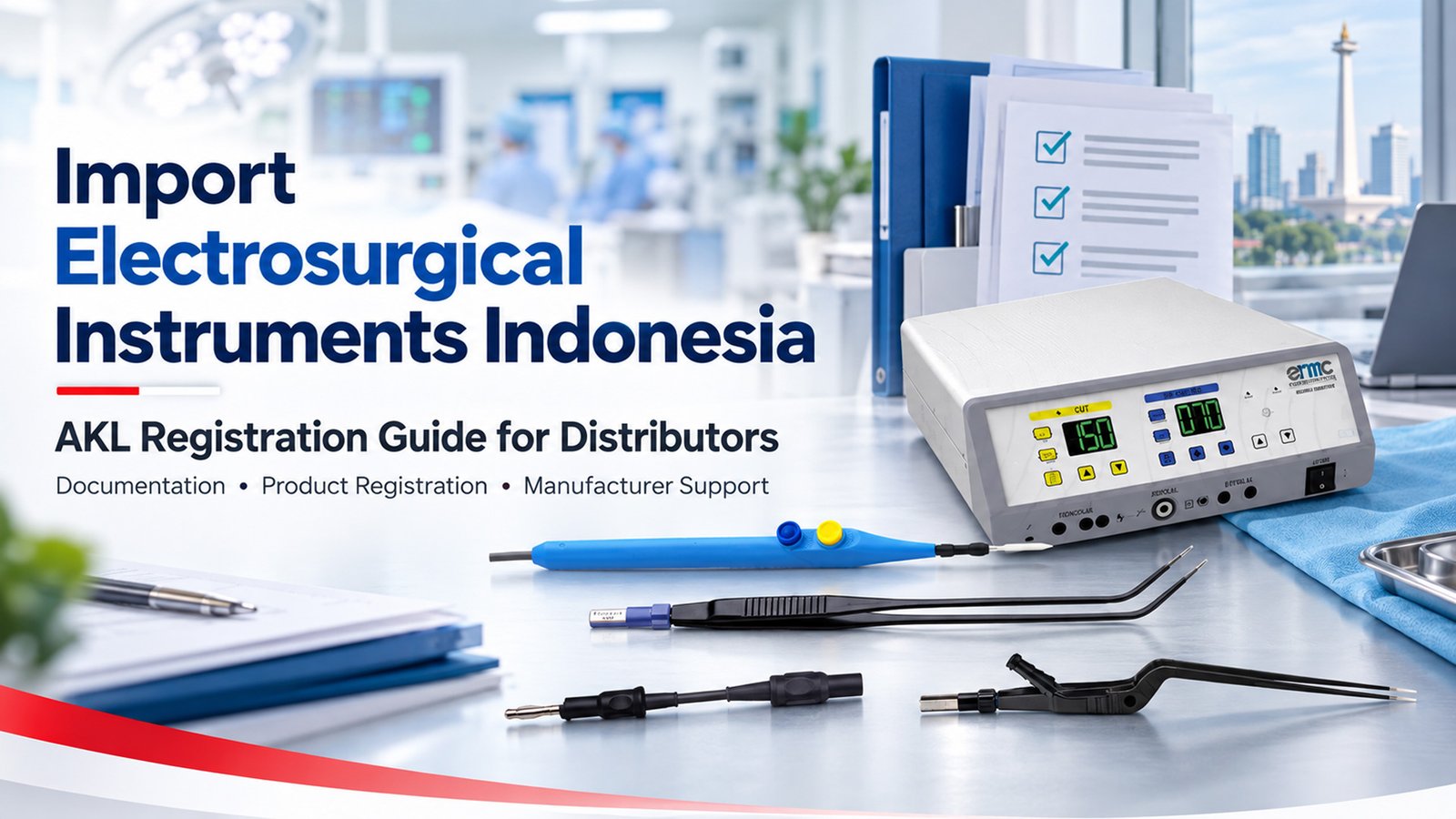
 Indonesian distributors adding bipolar forceps, diathermy pencils, electrosurgical cables or patient return electrodes to their portfolio must clear one step before any hospital order: registration with the Ministry of Health of the Republic of Indonesia (Kemenkes RI). This guide explains who registers, what the foreign manufacturer supplies and where applications usually stall.
To import electrosurgical instruments into Indonesia, a locally licensed medical device distributor must obtain an AKL marketing authorisation from Kemenkes through the online Regalkes system. The foreign manufacturer supports the application with an embassy-legalised Letter of Authorization, a Certificate of Free Sale, ISO 13485 evidence and complete technical documentation.
Who Registers Imported Electrosurgical Devices in Indonesia?
Indonesian regulation places legal responsibility for an imported device on a local company, not on the overseas factory. Kemenkes defines the applicant as the producer or distributor submitting the registration, and the principal as the manufacturer, or its appointed overseas representative, that authorises an Indonesian importer.
- The manufacturer (principal) produces the instruments and supplies technical and quality documentation.
- The Indonesian distributor holds a valid medical device distribution licence, operates under CDAKB (Good Distribution Practice for Medical Devices), submits the AKL application and becomes the legal holder of the authorisation.
- Kemenkes RI evaluates safety, quality and performance and issues the marketing authorisation.
Because the AKL number is held by the Indonesian distributor, choosing a manufacturing partner is a long-term decision. Changing suppliers later generally means new authorisation letters and new registrations.
What the AKL Number Tells Hospital Buyers
Every medical device legally sold in Indonesia carries a marketing authorisation number. Imported devices use the AKL prefix and domestically manufactured devices use AKD. Hospital procurement teams, including those buying through the government e-Katalog, check this number before approving a product.
Indonesia classifies medical devices by risk from Class A (low) to Class D (high). The class assigned to a specific electrosurgical accessory affects how deeply it is evaluated. Classification depends on intended use, invasiveness and whether the device is active, so it should be confirmed product by product rather than assumed for a whole catalogue.
Documents the Foreign Manufacturer Provides
Most registration delays trace back to incomplete or inconsistent manufacturer documents. Based on Kemenkes guidance for imported medical devices, distributors should request the following before starting an application.
| Document | What Kemenkes looks for | Common problem |
|---|---|---|
| Letter of Authorization | Legalised by the Indonesian Embassy (KBRI) or a government representative in the country of origin; valid for at least two years; names the distributor exactly as on its licence; lists the products; states whether the appointment is as sole agent. | Distributor name or address differs from the licence; product list too vague. |
| Certificate of Free Sale | Issued by the competent authority in the manufacturer’s country, confirming the devices are legally marketed there. | Product names do not match catalogue or label names. |
| Quality management system evidence | A current ISO 13485 certificate whose scope covers the device types being registered. | Certificate expired, or scope does not cover the product family. |
| Technical documentation | Specifications, materials, dimensions, photos or drawings, intended use, sterilisation method for sterile single-use items, and test reports where required. | Missing insulation or electrical safety data for active accessories. |
| Labelling and instructions for use | Label and IFU content that can be presented in Bahasa Indonesia and matches the registered product description. | Claims on the box differ from the technical file. |
For electrosurgical accessories, the detail most often queried is generator compatibility. Plug type, cable length and rated voltage should read identically across the technical file, the label and the product catalogue.
The AKL Registration Process Step by Step
New applications are submitted online through the Kemenkes Regalkes medical device registration portal. A typical sequence looks like this:
- Agree scope with the manufacturer. Decide which products enter Indonesia first and whether the appointment is exclusive.
- Obtain the legalised Letter of Authorization. Legalisation by KBRI or the relevant government office can take several weeks, so start early.
- Collect the Certificate of Free Sale, ISO 13485 certificate and technical file. Check that every product name, code and specification matches across documents.
- Confirm device classification for each product family with your regulatory consultant.
- Submit through Regalkes under the distributor’s company account.
- Respond to evaluator queries. Fast, precise technical answers from the manufacturer shorten this stage considerably.
- Receive the AKL number, then import, list and sell the product. Plan renewals well before expiry.
How to Structure the First Registration Wave
Registering a full electrosurgical catalogue at once is slow and costly. Most distributors start with high-turnover products that hospitals reorder regularly, then expand.
- First: single-use items with steady reorder demand, such as single-use electrosurgical instruments, diathermy pencils and patient return electrodes.
- Second: reusable instruments, including bipolar forceps for the Indonesian market and compatible bipolar and monopolar cables.
- Third: specialty lines such as active electrodes and micro dissection needles, LLETZ loops and laparoscopic electrosurgical instruments.
Registering instruments together with their matching cables avoids a common problem: forceps in stock that hospitals cannot connect to their existing generators.
Questions to Ask a Manufacturer Before Signing
- Is the ISO 13485 certificate current, and does its scope cover the product families you plan to register?
- Can the manufacturer issue a Certificate of Free Sale using the same product names as its catalogue and labels?
- How quickly can it answer Kemenkes evaluator questions with test data or technical clarification?
- Will it notify you in advance of design, material or labelling changes that could affect your registration?
- Can it support private-label supply if you later want to register products under your own brand?
Undisclosed product changes put the registration holder at risk. A manufacturer with formal change notification protects the distributor’s AKL, its hospital approvals and its reputation.
Working with Electro Range MFG Co.
Electro Range MFG Co. (ERMC) has manufactured electrosurgical instruments in Sialkot, Pakistan, since 2006, producing reusable and single-use bipolar forceps, monopolar forceps, diathermy pencils, active electrodes, electrosurgical cables and patient return electrodes in its own facility. Distributors preparing an Indonesian registration can request product specifications, labelling details and quality documentation for the products under discussion. Learn more about ERMC electrosurgical instrument supply for Indonesia, or read this guide in Bahasa Indonesia: panduan impor instrumen elektrosurgikal dan izin edar AKL.
This article offers general commercial and regulatory orientation. It is not legal or regulatory advice. Requirements can change, so confirm current rules with Kemenkes RI and a licensed Indonesian regulatory consultant before submitting an application.
Frequently Asked Questions
Can a foreign manufacturer sell electrosurgical instruments directly to Indonesian hospitals?
Not without a local registration holder. Imported medical devices need a Ministry of Health marketing authorisation (AKL), and the application is made by an Indonesian company holding a medical device distribution licence, acting on the manufacturer’s Letter of Authorization.
What does AKL mean on a medical device?
AKL is the prefix of the Indonesian marketing authorisation number for imported medical devices. Domestically manufactured devices carry an AKD number instead. The number shows that the Ministry of Health has evaluated the device for safety, quality and performance.
Which documents does the foreign manufacturer provide for AKL registration?
Typically a Letter of Authorization legalised by the Indonesian Embassy (KBRI) or a government representative in the country of origin, a Certificate of Free Sale from the competent authority, quality management system evidence such as ISO 13485, and technical documentation including specifications, labelling and instructions for use.
Does the Letter of Authorization have to appoint a sole distributor?
Kemenkes guidance asks the Letter of Authorization to state whether the distributor is appointed as sole agent. Where it is not a sole appointment, additional authorisation documents are required, so territory and exclusivity should be agreed before the letter is drafted and legalised.