



 Specialised Geometry Is Useful Only When Every Detail Matches the Intended Requirement
Special bipolar forceps are selected when a standard straight instrument does not provide the access, visibility, tip performance or fluid-management capability required by the intended surgical workflow. For procurement teams, distributors and OEM buyers, however, choosing a specialised design involves more than selecting an attractive catalogue image.
Tip material, shaft geometry, working length, connection type, insulation, suction capability, irrigation configuration and reprocessing requirements can all affect product suitability. A structured approval process therefore helps buyers compare models accurately and avoid preventable compatibility problems.
What Are Special Bipolar Forceps?
Special bipolar forceps are electrosurgical instruments developed for procedures or access conditions that may require a specialised tip, shaft or integrated feature. Their two opposing tips act as the working electrodes, allowing energy to pass through the tissue held between them when connected to a compatible bipolar electrosurgical system.
Compared with conventional patterns, a specialised model may include tungsten carbide tips, a bayonet shaft, an angled working end, an integrated suction channel, combined suction and irrigation or a particular connector arrangement.
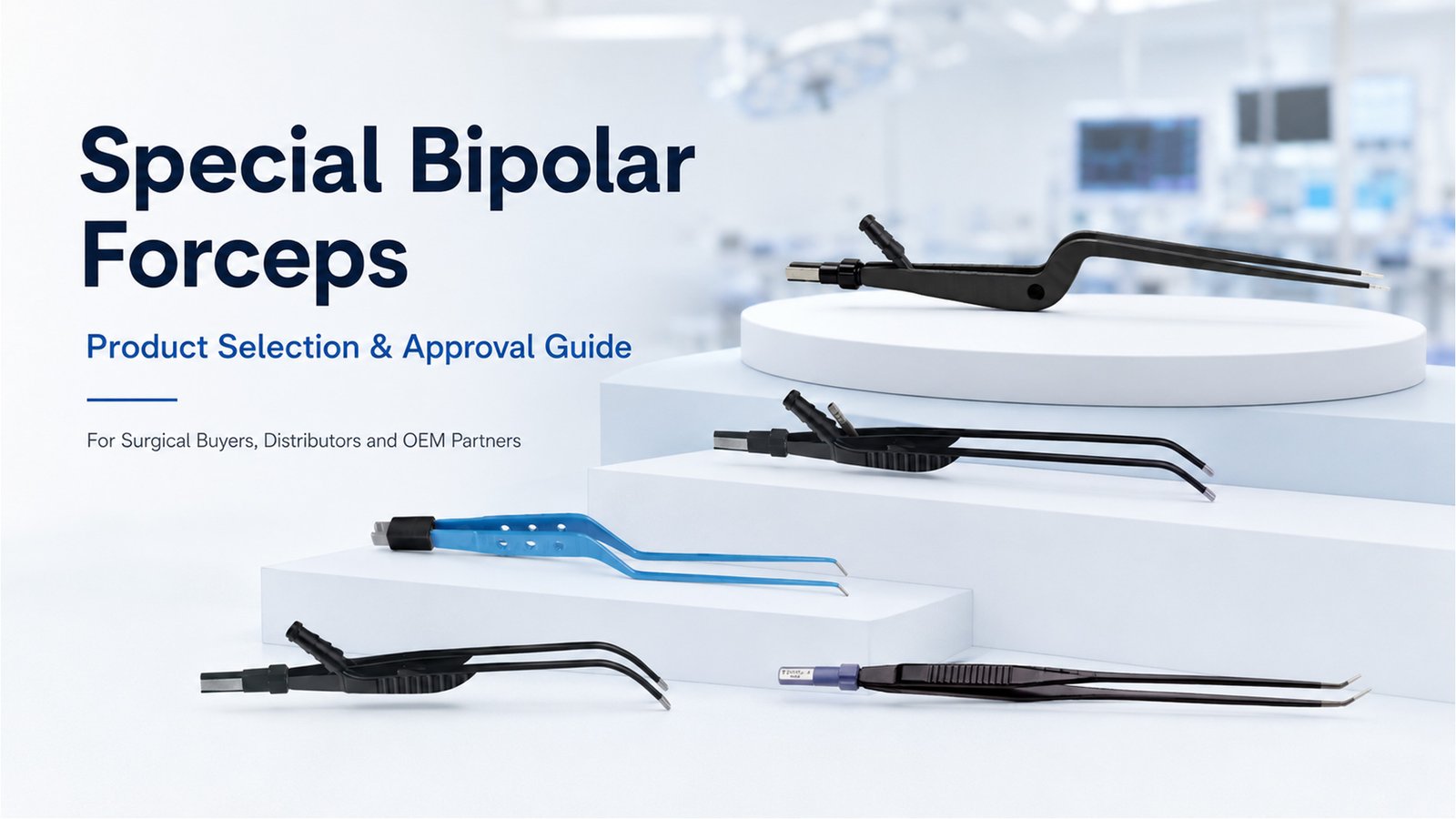
ERMC’s special bipolar forceps range includes straight, bayonet, angled, suction and suction-irrigation configurations for professional evaluation.
Why Special Bipolar Forceps Need a Separate Approval Process
A hospital or distributor may already have an approved standard bipolar forceps range. That approval should not automatically be extended to every specialised version. A change in tip angle, shaft profile or fluid-management feature may introduce different handling, cleaning, connection or maintenance considerations.
The approval team should therefore evaluate the complete configuration rather than treating the product name alone as sufficient evidence of equivalence.
Main Special Bipolar Forceps Configurations
Tungsten Carbide Bipolar Forceps
Tungsten carbide bipolar forceps use a specialised tip material selected for its working characteristics and durability. Buyers should confirm the precise tip construction, dimensions, alignment and maintenance requirements for the requested model.
Straight and Bayonet Bipolar Forceps
Straight bipolar forceps provide a direct instrument profile, while bayonet bipolar forceps offset the handle from the working line. The bayonet design may help preserve the operator’s viewing path in procedures where the hand or instrument body could otherwise obstruct visibility.
Angled and Curved-Tip Designs
Specialised forceps may be offered with angled or curved working ends, including configurations identified as 30-degree, 45-degree or 60-degree designs. Buyers should not select an angle solely from its numerical description. A physical sample or technical drawing can help confirm whether the direction, working length and tip orientation match the intended access route.
Suction Bipolar Forceps
Suction bipolar forceps combine bipolar handling with an integrated suction pathway. This can reduce the need to introduce a separate suction instrument in an already restricted working area. Procurement teams should verify the suction connection, internal channel design, cleaning process and compatibility with the facility’s suction setup.
Suction and Irrigation Bipolar Forceps
Suction and irrigation bipolar forceps add fluid-management functionality to the instrument. These products require particularly careful evaluation because the electrical, mechanical and fluid pathways must all be considered during approval and reprocessing review.
Configuration Comparison for Buyers
| Configuration | Possible Selection Reason | Points to Verify |
| Tungsten carbide tips | Specialised tip performance and durability requirements | Tip dimensions, alignment, material specification and care |
| Bayonet shaft | Improved viewing path around the instrument body | Shaft length, offset, balance and access |
| Angled or curved tip | Access to a defined anatomical or working position | Angle direction, tip orientation and working length |
| Integrated suction | Energy application and suction through one instrument | Suction connector, channel cleaning and flow requirements |
| Suction and irrigation | Combined energy and fluid-management workflow | Fluid connections, controls, reprocessing and leakage checks |
Nine Product Approval Checks
- Define the Intended Application
Start with a clear description of the clinical department, intended procedure category and required instrument function. The final suitability decision should remain with qualified clinical and technical personnel.
- Confirm the Tip Material and Profile
Verify tip width, length, shape, surface finish and material. Catalogue terms such as fine, micro, non-stick or tungsten carbide should be supported by an exact model specification.
- Review Shaft Geometry
Compare straight, bayonet and angled designs using technical drawings or samples. Confirm total length, working length, shaft offset and the direction of any bend.
- Evaluate Closing Alignment
The tips should meet consistently according to the instrument specification. Buyers should include tip alignment, closing pressure and return action in incoming inspection or sample evaluation.
- Check Suction and Irrigation Connections
For fluid-management models, verify port dimensions, tubing requirements and the proposed cleaning method. Internal channels must be included in the reprocessing assessment.
- Verify Insulation and Surface Condition
Inspect the insulated area, transitions and exposed working section. Hospitals should include insulation and surface checks in their local inspection programme before use and during the instrument’s service life.
- Match the Cable and Connector
A forceps pattern cannot be approved independently from its connection system. Confirm the bipolar cable, generator-side plug and instrument-side fitting for the exact configuration being ordered.
- Review Reprocessing Instructions
Confirm cleaning access, sterilisation method, inspection points and any model-specific restrictions. Products containing suction or irrigation channels may require additional attention during cleaning validation and routine processing.
- Approve Documentation and Identification
Technical specifications, product codes, packaging labels and instructions should identify the approved configuration clearly. This reduces the risk of a similar-looking but unsuitable model being supplied during a repeat order.
Common Purchasing Mistakes
- Selecting a model from a photograph without confirming dimensions.
- Assuming every bayonet or angled forceps has the same geometry.
- Approving the forceps without checking its bipolar cable connection.
- Ignoring internal-channel cleaning requirements for suction models.
- Using one general product code for several materially different configurations.
- Changing the tip, shaft or connector without repeating the relevant approval checks.
Support for Distributors and OEM Buyers
Distributors and private-label buyers should prepare a written specification before requesting commercial quotations. It should include the forceps pattern, length, tip design, material, suction or irrigation requirement, connector, packaging preference, expected quantity and required documentation.
When an exact configuration is not listed, a technical comparison can help determine whether an existing model is suitable or whether a custom-development discussion is required. Branding, packaging and market documentation should be agreed only after the physical and connection specifications have been approved.
Why Review the ERMC Special Bipolar Forceps Range?
ERMC presents a focused selection of tungsten carbide, bayonet, angled, suction and suction-irrigation bipolar forceps. Buyers can use the live category to identify possible configurations before requesting model-specific drawings, connector information, samples or commercial terms.
Explore the Special Bipolar Forceps category or review the wider Electrosurgery Forceps range.
Frequently Asked Questions
What makes a bipolar forceps a special model?
A special model generally includes a non-standard feature such as tungsten carbide tips, a bayonet or angled shaft, integrated suction, combined suction and irrigation or a specialised connection. The exact specification should always be confirmed by product code.
Are suction bipolar forceps interchangeable with standard forceps?
Not automatically. Suction models introduce additional connection, cleaning and workflow requirements and should receive their own technical and reprocessing review.
How should a buyer select the correct forceps angle?
Use the intended access requirement, technical drawings and preferably a sample evaluation. The numerical angle alone does not confirm the direction or practical working position.
Do special bipolar forceps require a particular cable?
They may. Buyers should verify both the instrument-side and generator-side connections before approval or ordering.
Can special bipolar forceps be supplied for OEM programmes?
OEM possibilities depend on the requested configuration, quantities, documentation and branding requirements. Buyers should submit a complete specification for feasibility review.
Request a Product Evaluation
If you are evaluating special bipolar forceps for a hospital, distribution portfolio or OEM programme, send ERMC the intended configuration, tip design, length, connector, fluid-management requirement and estimated quantity. The team can help identify suitable catalogue options for further technical review.