



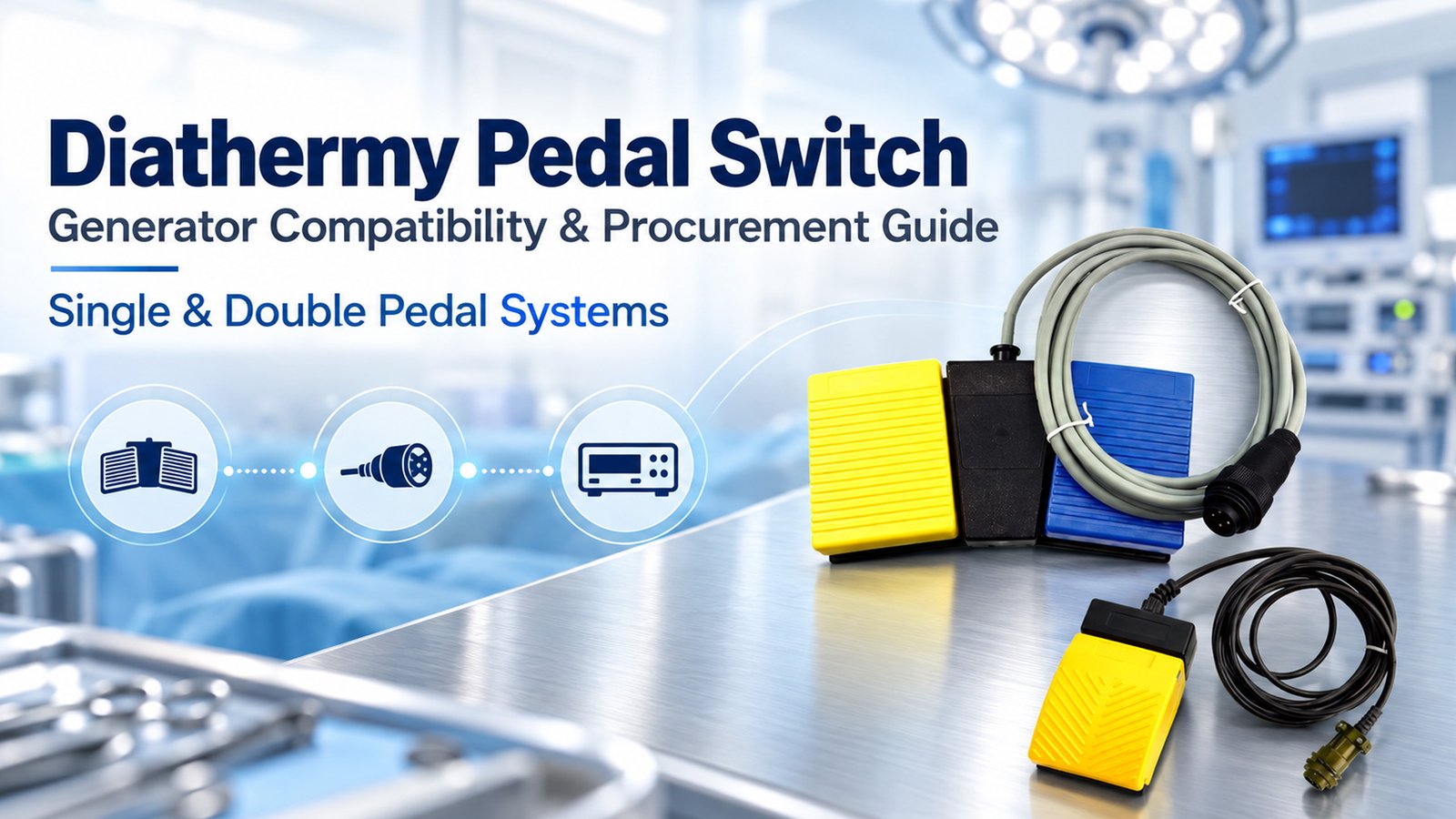
 A Footswitch Is Only Useful When Its Plug, Pedal Functions and Generator Logic Work Together
A diathermy pedal switch allows the operator to activate compatible electrosurgical functions through foot control. It can support a practical hands-free workflow, but it should never be treated as a universal accessory.
Generator connection, pedal number, switching logic, mode assignment, cable construction and intended equipment compatibility must all be verified. A footswitch that physically fits a socket may still be unsuitable if its internal control arrangement does not match the generator.
This procurement guide helps hospitals, distributors and OEM buyers compare electrosurgical footswitches accurately and create a safer, more organised approval process.
What Is a Diathermy Pedal Switch?
A diathermy pedal switch, also called an electrosurgical footswitch or diathermy foot pedal, is an external control accessory used with a compatible electrosurgical generator.
Depending on the design and equipment, it may provide one or more activation controls. The function assigned to each pedal depends on the generator and switch configuration and should not be assumed from pedal colour or position alone.
ERMC currently presents single- and double-pedal options in its Diathermy Pedal Switch category.
Single-Pedal and Double-Pedal Switches
Single-Pedal Diathermy Switch
A single-pedal diathermy switch provides one foot-operated control. The assigned function depends on the intended generator and system setup. Buyers should confirm the exact activation logic through the product and equipment documentation.
Double-Pedal Diathermy Switch
A double-pedal diathermy switch provides two separate controls. In some compatible systems, these may correspond to different electrosurgical modes, but their operation must be verified for the precise generator model.
A two-pedal product should not be described as cut-and-coag compatible unless that function is confirmed for the intended equipment.
Single vs Double Pedal Comparison
| Selection Area | Single Pedal | Double Pedal |
| Controls | One foot-operated input | Two separate foot-operated inputs |
| Function | Defined by the compatible generator and setup | Each pedal requires confirmed mode assignment |
| Main compatibility check | Plug, switching logic and generator response | Plug, switching logic and both pedal functions |
| Acceptance test | Verify the intended single function | Verify each pedal independently |
Why Physical Connection Is Not Enough
A plug that enters the generator socket does not prove full compatibility. The complete review may need to consider:
- Connector shape and dimensions.
- Pin number, spacing and orientation.
- Switching circuit and contact arrangement.
- Single- or double-pedal configuration.
- Function assigned to each pedal.
- Generator software or mode behaviour.
- Cable length and strain relief.
For this reason, a diathermy footswitch should be approved for a defined generator model rather than for a brand name alone.
Ten Procurement and Compatibility Checks
- Record the Generator Manufacturer and Model
Begin with the complete generator identification. A manufacturer may use different footswitch connections across its equipment range.
- Confirm the Required Number of Pedals
State whether the requirement is for a single- or double-pedal switch. Do not use the terms interchangeably in quotations or purchase orders.
- Define the Intended Functions
Document which control function or functions are required. Mode assignments should be confirmed from the generator and footswitch documentation.
- Verify the Connector and Pin Arrangement
Compare the plug shape, pin configuration, locking mechanism and socket orientation. Product photographs should support—not replace—technical confirmation.
- Review Cable Length
The cable must provide appropriate reach between the generator and intended footswitch position. Excessively short or unnecessary excess cable can complicate room setup.
- Examine Cable Entry and Strain Relief
Review the connection between the cable, pedal housing and equipment plug. These areas should also be included in routine inspection procedures.
- Consider Pedal Stability
The housing, base and pedal action should be evaluated within the intended working environment. Do not claim anti-slip or fluid-resistant performance unless supported by the exact product specification.
- Review Cleaning Instructions
Confirm the permitted cleaning method and any restrictions for the pedal housing, cable and connector. A footswitch should not be immersed, disinfected or processed using an unapproved method.
- Complete a Functional Test
Qualified technical personnel should verify that each pedal activates only the intended generator function. Testing should follow the organisation’s equipment-acceptance procedure.
- Establish Inspection and Replacement Controls
Routine checks should consider the pedal action, housing, cable, strain relief and connector condition. Damaged accessories should be managed according to the facility’s equipment policy and manufacturer instructions.
Relationship with Foot-Control Cautery Pencils
A foot-control cautery pencil and a diathermy pedal switch may be used within the same broader equipment workflow, but they are separate accessories.
The pencil must match the active-electrode and generator connection requirements, while the pedal switch must match the generator’s foot-control interface and switching logic. Approving one component does not automatically approve the other.
Common Purchasing Mistakes
- Ordering by generator brand without specifying its model.
- Assuming every two-pedal switch has the same functions.
- Matching the plug shape but ignoring the switching circuit.
- Failing to specify cable length.
- Accepting a replacement without functional testing.
- Using unsupported cleaning or immersion methods.
- Failing to distinguish single- and double-pedal article numbers.
- Describing a product as universal without documented compatibility.
How to Prepare a Professional RFQ
A complete diathermy pedal switch enquiry should include:
- Generator manufacturer and model.
- Existing footswitch reference where available.
- Single- or double-pedal requirement.
- Required control functions.
- Connector photographs or technical drawings.
- Required cable length.
- Expected order and annual quantities.
- Destination market.
- Required technical and commercial documentation.
Distributor and OEM Programme Planning
Distributors should maintain a compatibility table showing which switch is approved for each generator model. Commercial staff should avoid recommending a footswitch from appearance alone and should have a clear process for technical confirmation.
OEM programmes require agreement on the pedal housing, connector, cable, labelling, packaging and intended generator. Any technical change should be reviewed before the updated product enters supply.
Why Review ERMC Diathermy Pedal Switches?
ERMC lists single- and double-pedal options within its Electrosurgical Essential Accessories portfolio. These accessories can be evaluated alongside ERMC’s Diathermy Machines and System Packs.
Exact switch functions, generator compatibility, cable specifications and cleaning instructions should be confirmed for the requested reference.
Frequently Asked Questions
Can one diathermy pedal switch work with every generator?
No. Compatibility depends on the connector, switching circuit, mode assignment and generator requirements.
What is the difference between a single and double pedal?
A single-pedal model provides one control input, while a double-pedal model provides two. The actual function of each input depends on the approved generator setup.
Does a matching plug guarantee compatibility?
No. The internal switching arrangement and generator response must also be verified.
Can a footswitch be cleaned by immersion?
Do not immerse or process the product unless the instructions for the exact model explicitly permit that method.
Can ERMC support OEM pedal switch supply?
OEM feasibility depends on the generator interface, pedal configuration, quantities, branding, packaging and documentation requirements.
Request a Footswitch Compatibility Review
Send ERMC the generator manufacturer, model, socket information, required pedal configuration, intended functions and estimated volume. These details support a more accurate diathermy pedal switch evaluation.