



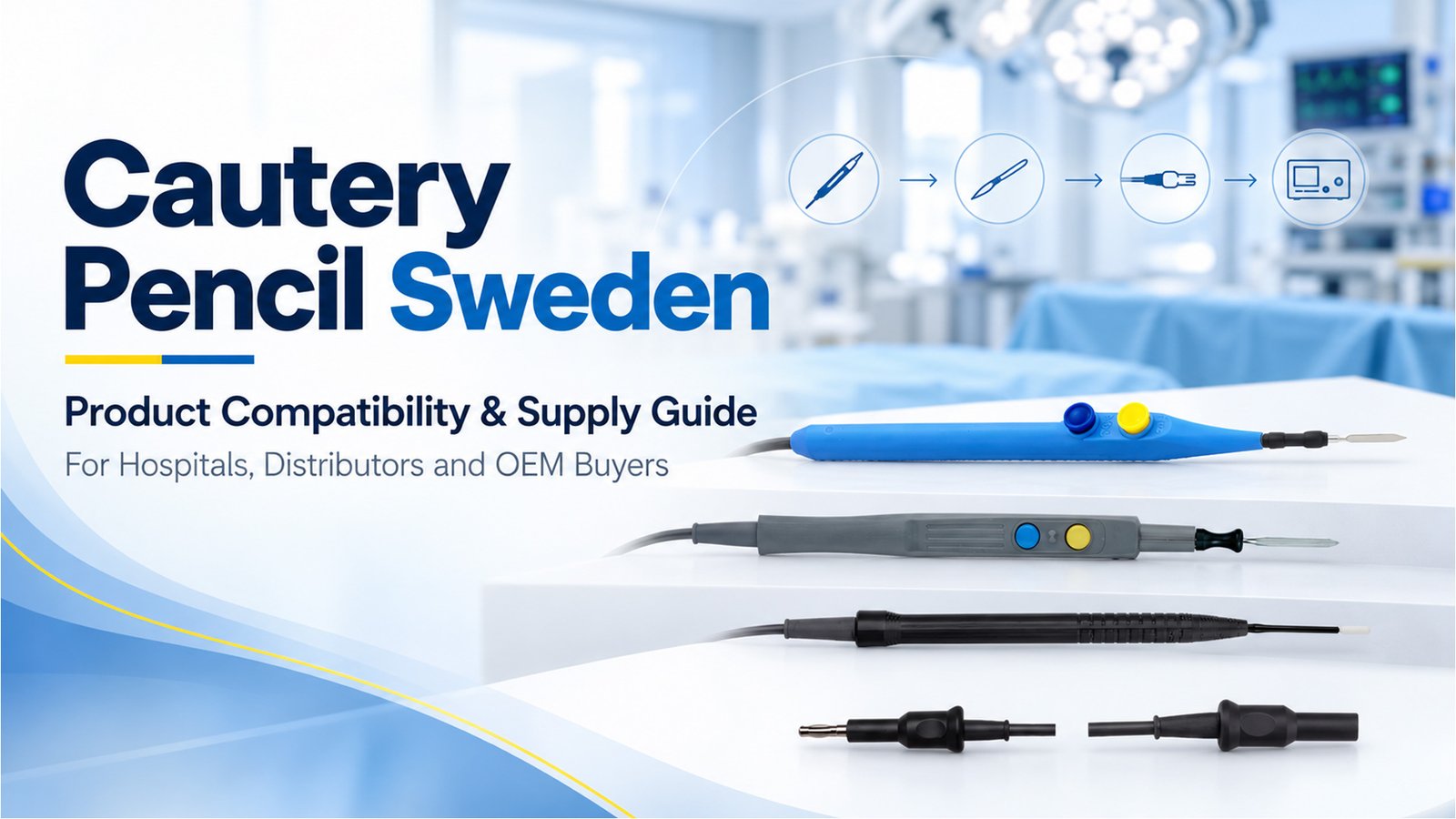
 A Strong Sweden Supply Programme Connects the Pencil, Electrode, Cable and Generator
Professional buyers sourcing a cautery pencil in Sweden should evaluate it as part of a complete electrosurgical accessory system. A suitable pencil must connect correctly to the intended generator, accept the approved electrode and support the selected hand-control or foot-control workflow.
Compatibility is only the first stage. Hospitals, distributors and OEM buyers must also consider reprocessing or sterile supply, product identification, stock continuity, documentation and change control. These factors influence the reliability of the programme after the initial product approval.
Understanding the Complete Cautery Pencil System
A cautery pencil does not operate as an isolated accessory. Its practical configuration may include:
- The pencil or handpiece body.
- A hand-control switching system or generator footswitch.
- A fixed or detachable cable.
- A generator-side connector.
- A replaceable or supplied active electrode.
- Reusable-processing instructions or sterile single-use packaging.
A change to any one of these components can affect the approved combination. Professional buyers should therefore document the complete system rather than recording only a general product name.
ERMC’s Diathermy Cautery Handpiece range provides several configurations for initial product comparison.
Cautery Pencil Types for Product Evaluation
Hand-Control Cautery Pencils
A hand-control cautery pencil places the activation controls on the instrument body. Where separate cut and coagulation buttons are provided, the buyer should confirm their identification, switching function and compatibility with the selected generator.
Review available configurations in the Hand-Control Cautery Pencils category.
Foot-Control Cautery Pencils
A foot-control cautery pencil relies on the generator’s compatible footswitch arrangement for activation. Buyers should verify the complete workflow, including the electrode fitting, cable connection, generator socket and footswitch function.
Different shaft fitting options can be reviewed in the Foot-Control Cautery Pencils category.
Reusable and Detachable Handpieces
Reusable or detachable cautery handpieces may support a planned reprocessing and component-replacement programme. The buyer should determine whether the pencil, cable and electrode are processed together or handled as separate components.
View ERMC’s Detachable Cautery Handpieces for relevant configurations.
Sterile Single-Use Cautery Pencils
A single-use cautery pencil is supplied for one use according to its labelling. It may simplify procedure preparation, but its adoption requires reliable forecasting, stock rotation, shelf-life monitoring and disposal planning.
Buyers can review ERMC’s Single-Use Diathermy Cautery Pencils.
Reusable vs Single-Use Supply
| Evaluation Area | Reusable Cautery Pencil | Single-Use Cautery Pencil |
| Preparation | Requires approved cleaning, inspection and sterilisation | Supplied in its defined sterile or ready-to-use pack |
| Routine control | Track condition, reprocessing and service life | Track sterile integrity, expiry and stock rotation |
| Cost assessment | Purchase plus processing, inspection and replacement | Per-unit purchase, storage, disposal and replenishment |
| Supply risk | Replacement availability and component continuity | Ongoing consumption and minimum stock requirements |
| Approval focus | Compatibility and validated reprocessing workflow | Compatibility, sterile barrier and supply continuity |
Nine Compatibility and Supply Checks
- Record the Generator Details
Document the manufacturer, model, available socket and current accessory reference. This information is more reliable than ordering a pencil described simply as “standard” or “universal”.
- Choose Hand or Foot Activation
The activation method must reflect the intended equipment and working process. Hand- and foot-control products should be treated as separate configurations during evaluation, stock management and purchasing.
- Confirm the Electrode Fitting
Identify the accepted electrode shaft diameter and retention mechanism. Available configurations may support 1.6 mm, 2.4 mm, 4.0 mm or multiple shaft sizes, depending on the exact model.
- Verify the Cable and Plug
Check cable length, fixed or detachable construction, strain relief, plug shape and pin arrangement. Visual similarity alone is not evidence of electrical or functional compatibility.
- Review Handling and Control Identification
For hand-controlled pencils, assess the positioning and identification of cut and coagulation controls. A sample evaluation can also review grip, balance, cable movement and electrode retention.
- Approve Reprocessing or Sterile Supply
Reusable models need approved instructions covering cleaning, inspection, sterilisation and removal from service. Single-use models require review of sterile-barrier information, shelf life, storage and single-use labelling.
- Check Documentation and Market Presentation
Review the technical specification, product labelling, instructions and applicable conformity documentation for the exact model. Swedish and European language, importer, distribution and market requirements should be confirmed by appropriately qualified personnel.
- Establish Article Numbers and Change Control
Each approved combination should have a clear article number. Changes to the electrode fitting, plug, cable, control type, packaging or sterile status should trigger a documented review rather than being treated as an automatic substitute.
- Plan Repeat Supply
Agree forecast volumes, pack quantities, expected lead times and minimum stock levels. For high-consumption single-use products, replenishment planning should begin before the initial stock is placed into routine use.
Evaluate Total Programme Cost
The lowest purchase price does not always represent the lowest programme cost. A more useful comparison includes all resources needed to keep the product available, compatible and ready for use.
For reusable pencils, this may include cleaning, sterilisation, inspection, cable replacement and removal of damaged products. For single-use pencils, include recurring unit cost, storage, expiry control, waste handling and emergency stock.
Compatibility failures also carry an operational cost. A lower-priced pencil provides little value if it cannot connect to the installed generator or accept the hospital’s approved electrode.
Creating a Standardised Product Specification
A standardised specification for cautery pencil Sweden purchasing should contain:
- Product type and activation method.
- Accepted electrode shaft size.
- Generator manufacturer and model.
- Generator-side plug and switching arrangement.
- Cable length and fixed or detachable design.
- Reusable or single-use status.
- Packaging and product identification.
- Required documentation and destination market.
- Approved sample or reference product information.
This structure helps purchasing teams compare like-for-like quotations and reduces ambiguity during repeat orders.
Distributor and OEM Supply Planning
A Swedish distributor should select the initial range around genuine equipment and customer requirements. A controlled range covering the most relevant control types, shaft sizes and plugs is easier to support than a catalogue containing many poorly differentiated references.
OEM buyers should provide the full technical specification together with packaging, artwork, branding, quantity and documentation expectations. Product, cable and generator compatibility should be approved before private-label materials are finalised.
Why Review ERMC Cautery Pencil Options?
ERMC offers a structured range of hand-control, foot-control, detachable and sterile single-use cautery pencils. This gives hospitals, distributors and OEM buyers multiple starting points for matching the intended electrode, activation method and generator connection.
ERMC describes selected cautery handpieces with characteristics such as a slim profile, sealed construction, responsive controls and heat-resistant design. Exact features, reprocessing limits and compatibility information should be confirmed for the selected reference.
Frequently Asked Questions
What is the most important cautery pencil compatibility check?
No single check is sufficient. The activation method, electrode fitting, cable, generator-side plug and intended generator should be assessed together.
Does a universal electrode fitting guarantee generator compatibility?
No. An electrode fitting relates to the working electrode, while generator compatibility also depends on the cable, connector and switching arrangement.
How should Sweden-based buyers compare reusable and single-use pencils?
Compare the complete workflow, including purchase price, reprocessing, inspection, sterile availability, stock management, disposal and supply continuity.
Can an approved cautery pencil be replaced by a similar model?
A substitute should be reviewed whenever there is a material difference in its controls, electrode fitting, connector, cable, packaging or processing requirements.
Can ERMC support distributor or OEM enquiries for Sweden?
Buyers can submit their technical configuration, destination market, quantity, packaging and branding requirements for product and commercial feasibility review.
Request a Cautery Pencil Sweden Evaluation
For a cautery pencil Sweden enquiry, provide the generator model, hand- or foot-control requirement, electrode shaft size, cable and plug details, reusable or single-use preference and estimated annual volume. ERMC can use these details to identify relevant options for technical evaluation.