



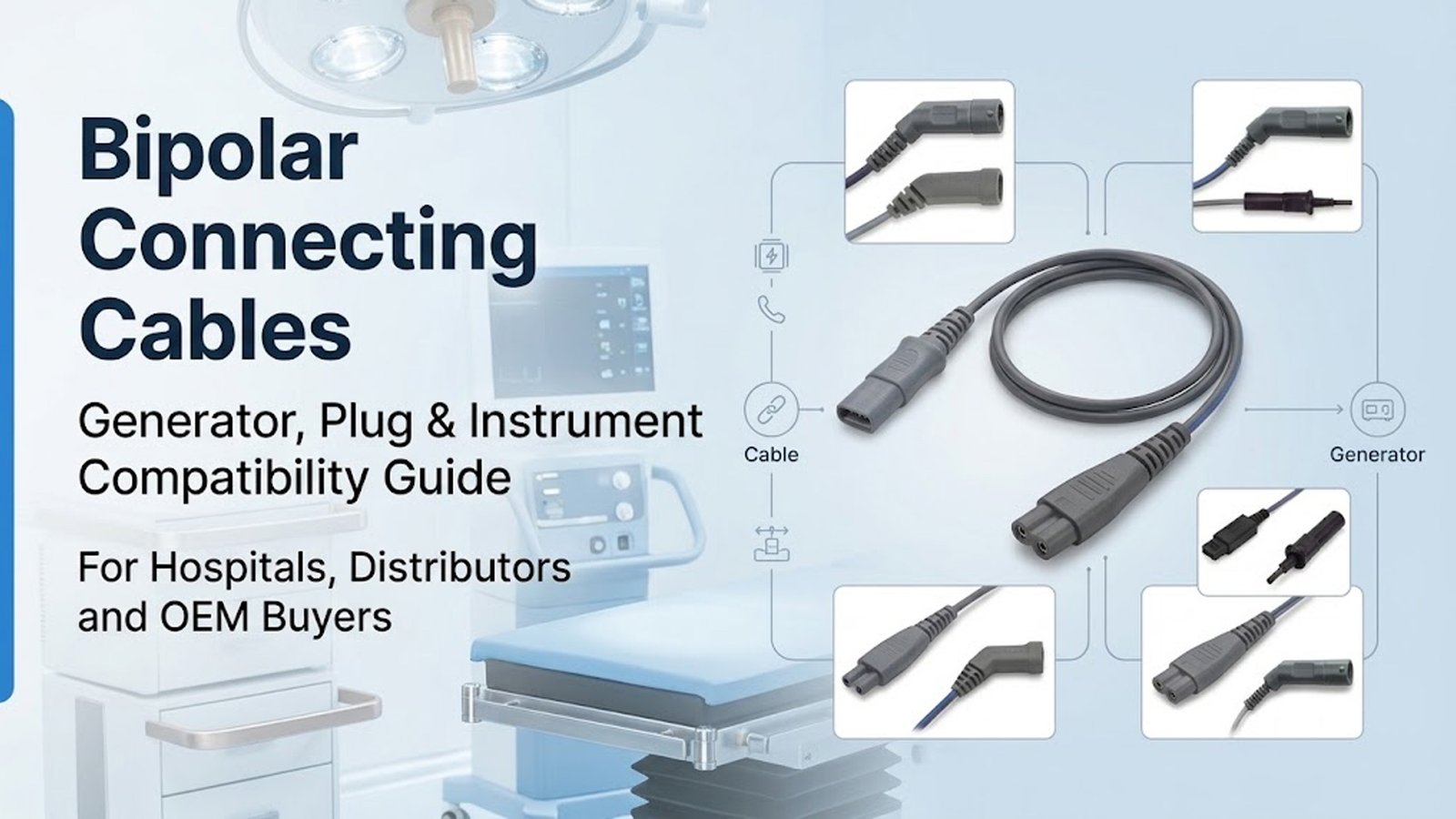
 The Cable May Look Right—But One Connector Mismatch Can Stop the Entire Electrosurgical Setup
Bipolar connecting cables create the electrical connection between a bipolar instrument and a compatible electrosurgical generator. They may appear to be simple accessories, but their connectors, pin arrangements, cable construction and intended equipment compatibility can vary considerably.
A cable should never be selected solely because its plug appears similar to an existing model. Hospitals, distributors and OEM buyers need to confirm the instrument-side fitting, generator-side plug and complete cable specification before approving a product.
This guide explains how to compare bipolar electrosurgical cables accurately, reduce ordering errors and create a more reliable repeat-supply programme.
What Is a Bipolar Connecting Cable?
A bipolar cable connects a compatible bipolar instrument—such as bipolar forceps—to the bipolar output of an electrosurgical generator. It provides the conductive pathway needed for energy delivery through the connected instrument.
The cable normally has two important interfaces:
- The instrument-side connector that attaches to the bipolar forceps or other compatible instrument.
- The generator-side connector that fits the intended electrosurgical unit.
Both interfaces must be correct. A suitable generator-side plug does not compensate for an incorrect forceps fitting, and a cable that attaches to the instrument is not automatically compatible with the generator.
Professional buyers can review ERMC’s Bipolar Connecting Cables as a starting point for model comparison.
Why Bipolar Cables Are Not Universally Interchangeable
The phrase “standard bipolar cable” is too general for dependable procurement. Different electrosurgical systems may use flat plugs, angled plugs, two-pin arrangements, universal-style connectors or other proprietary interfaces.
Differences may also exist in:
- Connector shape and dimensions.
- Pin spacing and contact arrangement.
- Instrument-side fitting.
- Cable length and flexibility.
- Insulation and strain-relief construction.
- Reusable or single-use designation.
- Cleaning and sterilisation requirements.
These differences explain why visual comparison alone is not a reliable compatibility test.
Common Bipolar Cable Configurations
Flat-Plug Bipolar Cables
A flat-plug bipolar cable uses a flattened generator-side connector. Straight and angled configurations may be available. Buyers should confirm the plug dimensions, contact positions and intended generator models.
Angled Bipolar Cable Connectors
An angled connector changes the direction in which the cable exits the equipment socket. This may support a particular equipment arrangement, but the angle should not be selected without confirming available space and connection orientation.
Two-Pin Bipolar Cables
A two-pin bipolar cable uses two separate electrical contacts at the relevant connection point. Pin diameter, distance and connector housing can vary, making exact reference matching essential.
Universal-Plug Options
Some products are described as having a universal bipolar plug. The term should be treated as a product designation rather than a guarantee that the cable will fit every generator. Compatibility must still be confirmed against the equipment model.
Special-Edition Cables
Special cable configurations may be developed for laparoscopic instruments, pad electrodes, specialised fittings or particular equipment families. These options require the same disciplined compatibility review as standard cables.
Three-Part Compatibility Check
| Compatibility Area | What to Confirm | Common Purchasing Risk |
| Instrument side | Forceps fitting, connector shape and contact arrangement | The cable fits the generator but not the instrument |
| Generator side | Equipment brand, model, socket and pin configuration | A visually similar plug is ordered for the wrong generator |
| Cable construction | Length, insulation, strain relief and reusable status | The connectors match, but the cable is unsuitable for the intended workflow |
Ten Checks Before Approving a Bipolar Cable
- Record the Generator Manufacturer and Model
Begin with the equipment information. Record the generator manufacturer, model, relevant socket and current cable reference where available.
- Identify the Connected Instrument
Specify whether the cable will connect to standard, non-stick, bayonet, suction or special bipolar forceps. Provide the instrument reference or a clear connector drawing.
- Confirm Both Connector Ends
A complete specification should identify the generator-side plug and instrument-side fitting separately. Photographs can support the review but should not replace dimensional or technical confirmation.
- Check Pin Arrangement
Confirm pin number, diameter, spacing and orientation where relevant. Small dimensional differences can prevent a secure connection.
- Select an Appropriate Cable Length
The cable should provide the necessary working reach without introducing unnecessary excess. Buyers should state the required length in the enquiry rather than assuming one standard measurement.
- Review Cable Flexibility
Handling characteristics can affect setup and cable routing. The sample review should consider flexibility, memory, tangling and the transition between the cable and connector.
- Inspect Insulation and Strain Relief
Review the cable jacket, connector housing and strain-relief areas. Hospitals should include these points in their local pre-use and reusable-accessory inspection procedures.
- Confirm Reusable or Single-Use Status
A reusable cable and a single-use cable require different purchasing, handling and replacement plans. Follow the exact product labelling.
- Review Reprocessing Instructions
For reusable models, confirm the permitted cleaning and sterilisation methods, inspection requirements and any stated processing limitations. Never apply instructions from a visually similar cable to a different reference.
- Complete a Functional Compatibility Review
Final approval should include appropriate technical assessment with the intended instrument and generator. This review should be completed by qualified personnel under the organisation’s established equipment-testing process.
Reusable vs Single-Use Bipolar Cables
Reusable bipolar cables may support repeated use when inspected and processed according to their validated instructions. Their programme cost should include cleaning, sterilisation, inspection, tracking and eventual replacement.
Single-use bipolar cables may support sterile, procedure-ready supply where that format is appropriate. Their procurement plan should consider pack integrity, shelf life, stock rotation, recurring volume and disposal.
Neither format is automatically suitable for every organisation. The correct choice depends on the approved workflow, equipment, product documentation and total cost of use.
Common Bipolar Cable Purchasing Mistakes
- Ordering from a connector photograph without confirming dimensions.
- Assuming a universal plug works with every generator.
- Checking the generator end but ignoring the instrument fitting.
- Using one purchasing description for several different plug patterns.
- Failing to specify the required cable length.
- Approving a reusable cable without reviewing its processing instructions.
- Substituting a new connector or cable construction without evaluation.
Building a Better RFQ for Bipolar Connecting Cables
A clear request for quotation should include:
- Generator manufacturer and model.
- Generator-side socket or current cable reference.
- Connected instrument type and product reference.
- Instrument-side fitting.
- Required cable length.
- Reusable or single-use preference.
- Estimated order and annual quantities.
- Destination market and documentation requirements.
- Photographs or drawings of both connectors where helpful.
OEM and Distributor Supply Planning
Distributors should organise their electrosurgical cable portfolio around generator and instrument compatibility rather than appearance. A compatibility chart connecting each cable reference to the approved equipment and instruments can simplify quotations and reduce incorrect orders.
OEM buyers should finalise the electrical and mechanical specification before developing branded packaging. Product codes should distinguish every material difference, including plug, fitting, length and reusable status.
Why Review ERMC Bipolar Connecting Cables?
ERMC presents multiple bipolar connecting cable configurations, including flat-plug, angled, two-pin, universal-style and special-edition options. These products sit within a wider Electrosurgical Cables and Connectors portfolio.
Buyers can also review the connected Electrosurgery Forceps range when developing a complete instrument-and-cable specification.
Frequently Asked Questions
Are bipolar connecting cables universal?
No universal compatibility should be assumed. Even products described as universal require confirmation against the intended generator and instrument.
What information is needed to identify a replacement cable?
Provide the generator brand and model, current cable reference, instrument reference, connector details, cable length and reusable or single-use requirement.
Can two cables with similar plugs be interchangeable?
Not necessarily. Pin arrangement, dimensions, electrical specification and instrument-side connection may differ.
Can reusable bipolar cables be sterilised?
Only use the methods stated in the instructions for the exact cable. Processing requirements should never be assumed from another product.
Can ERMC support OEM bipolar cable enquiries?
OEM feasibility depends on the connector configuration, cable specification, volume, packaging and documentation requirements. Submit a complete specification for review.
Request a Bipolar Cable Compatibility Review
Send ERMC the generator model, bipolar instrument reference, connector details, required cable length and estimated quantity. This information helps identify relevant bipolar connecting cables for further technical evaluation.